
This article explores AI literacy, providing practical strategies to help you navigate the digital age with greater awareness and resilience.
From developing critical thinking skills to understanding the ethical implications of AI, it covers some of the tools needed to engage flexibly and healthily with the diverse realities we encounter daily.
In our rapidly evolving digital world, artificial intelligence (AI) and other technologies have drastically transformed how we perceive and engage with reality.
While the historical journey through the Age of Faith, Enlightenment, and the Mobile and Social Information Age has shaped our understanding, we now find ourselves in the Age of AI and Digital Manipulation.
This era is characterized by the pervasive presence of AI, capable of generating highly realistic fake images, videos, and news stories, making it increasingly challenging to distinguish between what is real and what is not.
Navigating this complex landscape requires a new set of skills and a critical mindset. We must learn to engage with multiple realities—be it religious, scientific, cultural, or digital—while remaining discerning and resilient.
The key to thriving in this environment lies in building AI literacy, encompassing critical thinking, media literacy, technological awareness, and ethical considerations.

Critical Thinking
Critical thinking involves a set of skills and dispositions that are crucial for evaluating information in today’s noisy and reality-bending world.
It requires the ability to analyse arguments, identify biases, and recognise logical fallacies.
The rapid changes in the media landscape and the increasing use of AI tools highlight the urgent need for educational models that foster critical thinking. According to MIT Open Learning, generative AI has the potential to both aid and hinder educational outcomes, depending on how it is integrated into learning processes. This underscores the importance of teaching students to discern reliable information and develop higher-order thinking skills such as analysis, evaluation, and synthesis (Feijó 2023).
AI has the potential to significantly enhance human reasoning and critical thinking. It can help identify reasoning flaws, challenge deceptive explanations, and encourage deeper cognitive processing through structured questioning.
This dual role of AI, both in supporting and challenging our cognitive abilities, is crucial for fostering a discerning and rational citizenry capable of navigating the complexities of the modern world. Valdemar M. Danry’s research from MIT’s Programme in Media Arts and Sciences supports this perspective, emphasising the importance of cultivating these skills (Danry 2023, 2-5).
Websites like TeachThought provide a broad collection of resources to help educators and learners develop these skills. Their resources include books, videos, graphics, and models that promote thoughtful analysis and reasoning.
The Foundation for Critical Thinking provides online courses, workshops, and a comprehensive library of materials to cultivate intellectual empathy, humility, perseverance, integrity, and responsibility. These attributes are essential for navigating the complexities of the digital age, where misinformation can easily spread.
Online learning platforms like Coursera also offer courses on critical thinking.The courses emphasise the importance of questioning assumptions, evaluating evidence, and making reasoned decisions.
Also educational websites like Edutopia provide strategies for integrating critical thinking into curricula. They highlight the importance of selecting credible sources and designing activities that promote critical analysis. This includes using official sites, reputable newspapers, and trusted educational platforms to ensure the accuracy and reliability of information.
AwhiWorld also offers courses on navigating critical thinking with AI in particular. As we navigate the age of AI, critical thinking and scepticism are indispensable tools for discerning the truth in a sea of information. By developing these skills, we can better evaluate the sources and content we encounter, making informed and rational decisions in our personal and professional lives.
Media Literacy
Understanding how to evaluate the credibility of information is crucial – this includes learning to identify reputable sources and recognise bias and misinformation.
The American Press Institute emphasises that this involves “..understanding the role of media in society and developing the skills to critically evaluate content across different media platforms” (American Press Institute).
It’s a good idea to routinely use resources like Snopes, FactCheck.org, and the International Fact-Checking Network to verify information. These platforms provide reliable ways to cross-check claims and sources. Engaging with critically aware news sources like All Sides is also useful – they report from across the political spectrum.
Part of media literacy, combined with critical thinking, is never taking AI to be 100%. Check the content it brings you; links work, quotes are accurate, and what is being presented has been verified. AI should be used as a first port of call but never a final port of call for content generation.
It’s a great search tool for collaborating on writing, images, etc. But it hallucinates and does not know it is doing it (cyber psychosis). You can also ask it to verify or check itself. Often, it will realise it is wrong on a second or third pass, but sometimes it does not. In this case, you must research, check media sources, and do due diligence before publishing anything!
That includes checking all existing references and key facts that have not been made up. You will also want to check your work through a plagiarism system.
For images, systems are being developed by the day, so keep an eye on the news in AI detection. This post in Unite AI is regularly updated with a list, and there are others.

Tech Awareness
Stay informed about AI and other technologies’ capabilities and limitations.
Don’t bury your head in the sand. Particularly when AI is being integrated into everything!
Understanding how these tools work can help you better navigate the digital landscape. AwhiWorld has regular blogs and updates on the latest in AI tech. Subscribe to keep up to date with the latest in AI developments.
Being aware of how AI technologies are developed and used can help individuals make more informed decisions and mitigate potential risks.
Engage with programs and courses that support critical understandings of AI and skills in using different user interfaces. Make sure they are teaching you what to look for when using tools including IP and privacy issues that are sometimes hidden in the small print.
These resources can help you navigate the rapid changes caused by AI.
Contact AwhiWorld if you are interested in our own coaching packages or workshops.
Ethical Frameworks
Ethical Considerations
Consider the ethical implications of using AI and digital technologies.
Adopt ethical guidelines and practices to ensure responsible use at the organisational level or for your group.
You cannot presume any information generated is authentic, and funders, clients, etc., are developing programs to discern if the content you send them has been created by yourself or AI.
Some are enforcing this via contracts. Others don’t care if your presentation is well thought through and accurate.
But at least check! Developing AI protocols for your business or community group will support literacy over the whole system and give people some guidelines as to how best to use these tools or decipher their use by suppliers and others interfacing with your organisation. In this area, AwhiWorld can also help.

Shoring up Your Centre
Exercise Your Intuition and Feed Your Soul
Incorporate mindfulness and reflective practices into your routine to stay grounded and maintain a clear perspective on reality. Practices like meditation and journaling can help you process information more thoughtfully. You can also routinely step back from sources to breathe and assess.
Slowing down to reflect is never a bad thing unless it is a life-or-death situation.
Engaging with nature is also helpfully grounding after a big session of writing or creating. It can provide perspective after a deep dive into an AI rabbit hole or being triggered by content that may not even be true.
Its about feeding your soul, not just your brain via thinking and making.
Our own courses are holistic and ask you to really look at the balance between working on digital interfaces while also juggling important aspects of your life. What is a priority? What are tools to make your practice more effective and support your overall well being? And what AI tools help or hinder this?
The Increasing Risks of Power Outages and AI Dependency
As AI and other disruptive technologies continue to evolve, it is crucial to develop our AI literacy.
By developing critical thinking skills, media literacy, staying informed about technological advancements, and considering ethical implications, we can navigate this changing landscape with greater awareness and resilience.
This involves keeping our mental muscles sharp and consistently checking, verifying, and ensuring we are conscious of all the realities we encounter throughout the day. It also involves staying centred and grounded, reflecting actively, engaging with nature, and nourishing our souls so that our intuition flourishes.
In a world where reality is much more complicated than it used to be AI literacy is a critical aspect of personal and professional development. We’re here to support you in the AI literacy journey.
References
Coursera. “Introduction to Logic and Critical Thinking” Link
Edutopia. “Teaching With Web-Based Resources. Link
Danry, Valdemar M. “AI Enhanced Reasoning: Augmenting Human Critical Thinking with AI Systems.” Master’s thesis, Massachusetts Institute of Technology, 2023.MIT DSpace Link
FactCheck.org Link
Feijo, S. “What will the future of education look like in a world with generative AI?” MIT Open Learning. January 5, 2023. MIT Open Learning. Link
International Fact-Checking Network Link
Knight, Will. “Real or Fake? AI Is Making It Very Hard to Know.” MIT Technology Review, May 1, 2017 Link
McFarland, Alex. “5 Best Deepfake Detector Tools & Techniques (June 2024).” Unite.AI. June 3, 2024. Link.
Snopes Link
The Center for Critical Thinking Link
Note:
All images were generated by Midjourney | Text created in collaboration with various AI interfaces as part of Strange Intelligences Lab research.
Build Your Resilience Now!
At AwhiWorld, we support you and your organisation (group or community) in adapting to and leveraging AI technology.
Through our coaching, mentoring, and development experiences (workshops, labs, installations, publications), we help you navigate the complexities of AI, fostering innovation and sustainable growth.
Help us create a future where cutting-edge research and technology drive meaningful transformation.
Related Posts

AI for Creatives Hastings Art Gallery
Our latest AI intervention, 'AI & Creatives', took place at Hastings Art Gallery on 20 February 2026. The 2-hour interactive seminar covered the AI landscape, how it can be used (including emerging…

Knowledge Sharing – AUT University
Our second knowledge sharing session for our Growing Material Cultures project took place on the 29th November in the School of Future Environments at AUT University. Professor Frances Joseph brought together several…
Knowledge Sharing – Geoff Wilson Gallery
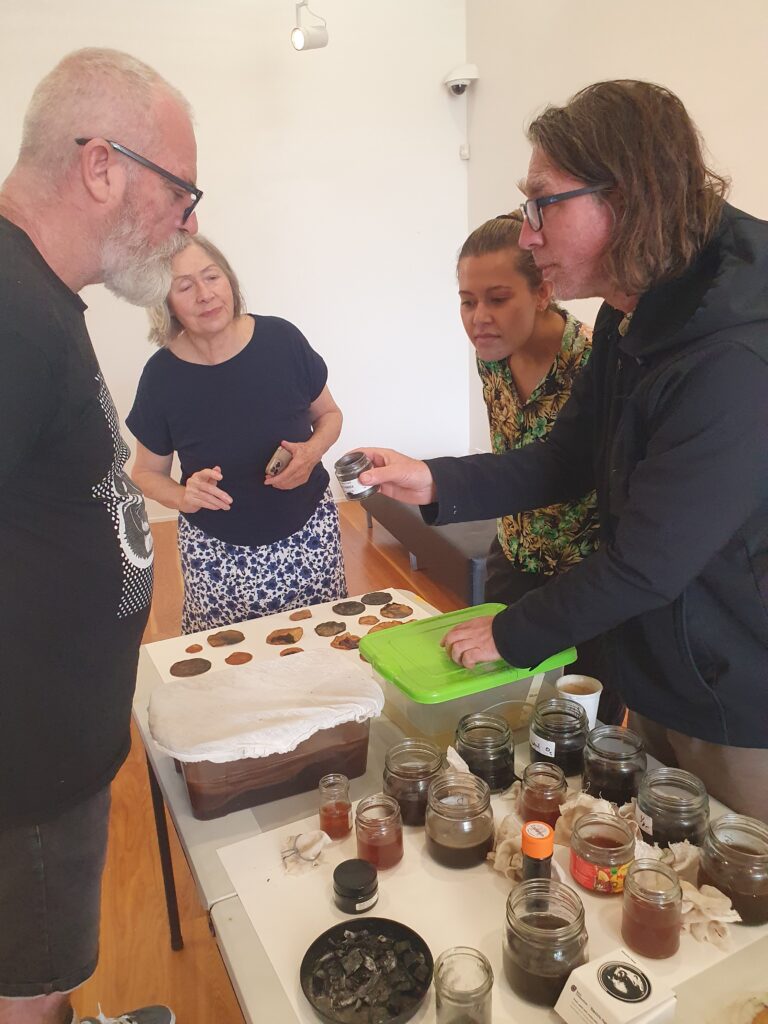
Sharing knowledge from experiments and kitchen based research was at the core of our session at Geoff Wilson Gallery on November 1st. Participants informally shared what they had been learning, their highs…

Interview with Kevin De Liban – Justice and The Algorithm
Interview with Kevin De Liban In this episode of Strange Intelligences, we speak with Kevin De Liban, a lifelong anti‑poverty advocate and founder of TechTonic Justice, about the hidden dangers of algorithmic decision…

Workshop Two: Growing Material Cultures
Strange new materials came to life in our hands today — from seaweed bioplastics to waterproofed biofilms. At Maunga Kura Toi, NorthTec, we held the second workshop in our Growing Material Cultures…

Notes from the Front Line
Strange Intelligences Creeping Strange Intelligence: Notes from the AI Frontline AI has slipped quietly into our creative lives, lurking in the background of almost every tool we use. It tidies our sentences,…

AI & What it Means to Be Human – Criticality and Resistance
AI and Multiple Realities We live in strange times. Reality is fragmented through social media channels into funnels of judgment, ego-driven humble bragging, or sponsored consumerism. Our lives, including our creativity, are…

AI Matariki
Matariki meets AI – Community-first innovation Today AwhiWorld had the privilege of spending Matariki Holiday at a powerful community gathering at the Whānau Focus Centre in Tūnatahi (Dargaville). We delivered a talk…

Workshop One: Growing Material Cultures
Workshop One in our Growing Material Cultures project was delivered at Maunga Kura Toi's studio in Raumanga and delivered by Professor Frances Joseph and Caudine Naselu. It covered how to grow Bacterial…

Fungi Hunting
Fungi Hunting - a super fun research expedition for the Growing Material Cultures project and part of the bigger AwhiWorld Strange Intellgences Lab project. Local expert and recent AwhiWorld interviewee, Caley McGillvery…