
Artificial Intelligence (AI) is changing our world faster than ever, and people react differently. These four AI attitudes can be grouped into Avoidance, Arrogance, Addiction, and Awe.
This post explores how each attitude has its opportunities and challenges.

Avoidance, Ambivalence, and Apathy
Many people avoid AI because they’re scared, don’t understand it, or worry about privacy and ethics. This can be a way to protect themselves and their organisations from potential problems.
For example, avoiding AI in healthcare or criminal justice can prevent unfair biases in decision-making. This fear is understandable, as high-profile AI failures, like biased facial recognition systems or flawed sentencing algorithms, highlight the potential dangers.
Ambivalence and apathy are also common. Ambivalence means having mixed feelings about AI, leading to hesitation. Apathy, a lack of interest or concern about AI, can cause people to miss out on what AI offers. While these attitudes can prevent us from jumping into AI too quickly, they can also mean missing out on benefits like increased efficiency and innovation.
They also prevent learning and criticality and prevention of negative impacts. You cannot understand technology and mitigate its impact on your life if you ignore it. Striking a balance between being cautious and engaging with AI is crucial for maximising its potential while managing its risks.
Additionally, personality traits such as openness to experience and demographic factors like age and education level significantly influence fear of AI. Younger, more educated individuals tend to be less afraid, while older individuals and those with less education often exhibit more fear (Varnum 2023).
As Forbes highlighted, avoiding AI can lead to missed opportunities, and failing to harness AI’s potential can be detrimental (Steinhorst 2023). Strategies to alleviate employees’ fears include clear communication about AI’s role and offering training programs to enhance understanding and comfort with the technology (Robinson 2024).
Arrogance
Arrogance in AI means thinking you know more about it than you do.
This overconfidence can be risky because it ignores new developments and best practices.
When people assume they know everything, they might not understand its limitations or biases, leading to poor decision-making. For example, a company might implement an AI system for hiring without realising the algorithm’s bias, resulting in unfair hiring practices and potential legal issues.
As highlighted by Forbes, the danger of arrogance is evident when users overlook AI’s flaws, such as hallucinations and inaccuracies (Press 2024).
On the flip side, confidence in AI knowledge can drive innovation and adoption of new technologies. However, it’s essential to keep learning and adapting.
Recognising that AI is complex and constantly evolving helps manage the risks of arrogance and promotes a more informed and responsible use of AI.
Staying updated with the latest AI research and developments ensures that one’s confidence is based on current, accurate information, leading to better decision-making and innovation.
Establishing clear AI ethics frameworks and governance policies in workplaces can address these concerns, as emphasised by The Australian Financial Review (AFR 2024).


Addiction
AI can be so fascinating and rewarding that some people become overly reliant or addicted.
This means diving into AI without thinking critically and often spending too much time using AI tools and apps. The very act of generating an image can give a strange sense of satisfaction every time a prompt brings up a new creation.
However, spending hours generating images with AI or obsessively analysing data can lead to burnout and a skewed sense of productivity. This can be particularly problematic for creative professionals or entrepreneurs who might be more captivated by AI’s potential than their core work.
The psychological impacts of AI, such as anxiety, social isolation, depression, and paranoia, emphasise the need for responsible AI usage and mitigating these risks (Banafa 2023).
Despite these challenges, deep engagement with AI can spark creativity and innovation. Immersing oneself in AI can lead to amazing discoveries and new applications.
Keeping a balance is essential, ensuring this engagement doesn’t overshadow critical thinking, personal well-being, or ethical considerations.
According to Ahmed Banafa, setting time limits on AI usage, maintaining a critical perspective, and integrating AI responsibly can help users harness its benefits while avoiding negative psychological impacts.
Practical strategies include ensuring there are boundaries for AI use, staying informed about AI developments, seeking support when feeling anxious or stressed, using AI systems responsibly, taking regular breaks, and advocating for the ethical use of AI (Banafa 2023).
Awe
Awe towards AI can inspire wonder and curiosity, driving people to explore and experiment with the technology.
This attitude can motivate, leading to significant advancements and a deeper understanding of what AI can do.
Being in awe of AI’s potential can inspire innovation and find new ways to use AI to improve human experiences and solve problems. This awe can fuel passion and dedication, leading to healthcare, art, and environmental science breakthroughs.
However, too much awe can blind people to AI’s limitations and risks. Overestimating what AI can do can lead to unrealistic expectations and ignoring significant ethical and practical concerns.
It’s vital to have an AI attitude that is rational, appreciating its potential while staying critical of its limitations and broader impacts.
The New York Times notes that AI tools often fall short of their grand promises, suggesting that realistic expectations are crucial for effectively harnessing AI’s potential (Angwin 2024).
Maintaining a critically aware, open and entrepreneurial AI attitude allows users to appreciate and leverage AI’s capabilities while remaining vigilant about its limitations and ethical considerations.
Conclusion
By understanding these four AI attitudes—avoidance (including ambivalence and apathy), arrogance, addiction, and awe—we can better navigate the complex world of AI.
Engaging with AI thoughtfully and responsibly will be key to unlocking its full potential ethically, fairly, and sustainably. It can also help combat issues like climate change or the impacts of extreme weather like power outages.
Balancing, harmonising, and resolving these attitudes toward a positive emergence can lead to agility in this fast-paced, changing digital world. This agility enables individuals and organisations to adapt quickly to new developments, make informed decisions, and innovate responsibly.
By fostering a balanced approach to AI, we can harness its transformative power while mitigating risks and ensuring its benefits are equitably distributed.
References
References
Varnum, Michael E. W. “Who’s Afraid of AI—and Why?” Psychology Today. December 15, 2023. Link.
Steinhorst, Curt. “Avoid These 4 AI Traps to Ensure It Works for You, Not Against You.” Forbes. July 5, 2023. Link.
Robinson, Bryan. “6 Strategies to Alleviate Employees’ Fears of AI in 2024.” Forbes. June 24, 2024. Link.
Banafa, Ahmed. “Psychological Impacts of Using AI.” BBVA OpenMind. May 8, 2023. Link.
Press, Gil. “The Year Of Hallucinating Artificial Intelligence And Arrogant Human Ingenuity.” Forbes. January 7, 2024. Link.
AFR. “Attitudes to AI: how we’re preparing for the next work frontier.” The Australian Financial Review. January 11, 2024. Link.
Angwin, Julia. “Press Pause on the Silicon Valley Hype Machine.” The New York Times. May 15, 2024. Link.
Note:
All images were generated by Midjourney | Text created in collaboration with various AI interfaces as part of Strange Intelligences Lab research.
At AwhiWorld, we support you and your organisation (group or community) in adapting to and leveraging AI technology.
Through our coaching, mentoring, and development experiences (workshops, labs, installations, publications), we help you navigate the complexities of AI, supporting healthy AI attitudes and fostering innovation and sustainable growth.
Help us create a future where cutting-edge research and technology drive meaningful transformation.
Related Posts

AI for Creatives Hastings Art Gallery
Our latest AI intervention, 'AI & Creatives', took place at Hastings Art Gallery on 20 February 2026. The 2-hour interactive seminar covered the AI landscape, how it can be used (including emerging…

Knowledge Sharing – AUT University
Our second knowledge sharing session for our Growing Material Cultures project took place on the 29th November in the School of Future Environments at AUT University. Professor Frances Joseph brought together several…
Knowledge Sharing – Geoff Wilson Gallery
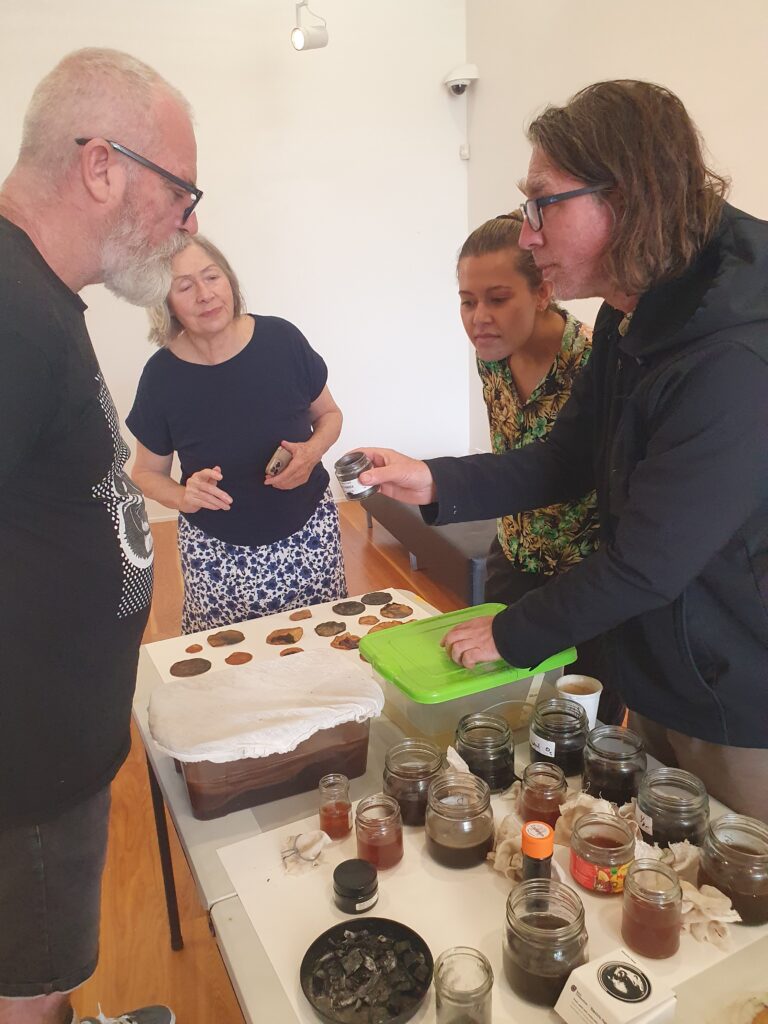
Sharing knowledge from experiments and kitchen based research was at the core of our session at Geoff Wilson Gallery on November 1st. Participants informally shared what they had been learning, their highs…

Interview with Kevin De Liban – Justice and The Algorithm
Interview with Kevin De Liban In this episode of Strange Intelligences, we speak with Kevin De Liban, a lifelong anti‑poverty advocate and founder of TechTonic Justice, about the hidden dangers of algorithmic decision…

Workshop Two: Growing Material Cultures
Strange new materials came to life in our hands today — from seaweed bioplastics to waterproofed biofilms. At Maunga Kura Toi, NorthTec, we held the second workshop in our Growing Material Cultures…

Notes from the Front Line
Strange Intelligences Creeping Strange Intelligence: Notes from the AI Frontline AI has slipped quietly into our creative lives, lurking in the background of almost every tool we use. It tidies our sentences,…

AI & What it Means to Be Human – Criticality and Resistance
AI and Multiple Realities We live in strange times. Reality is fragmented through social media channels into funnels of judgment, ego-driven humble bragging, or sponsored consumerism. Our lives, including our creativity, are…

AI Matariki
Matariki meets AI – Community-first innovation Today AwhiWorld had the privilege of spending Matariki Holiday at a powerful community gathering at the Whānau Focus Centre in Tūnatahi (Dargaville). We delivered a talk…

Workshop One: Growing Material Cultures
Workshop One in our Growing Material Cultures project was delivered at Maunga Kura Toi's studio in Raumanga and delivered by Professor Frances Joseph and Caudine Naselu. It covered how to grow Bacterial…

Fungi Hunting
Fungi Hunting - a super fun research expedition for the Growing Material Cultures project and part of the bigger AwhiWorld Strange Intellgences Lab project. Local expert and recent AwhiWorld interviewee, Caley McGillvery…