
Our colleague Frederico D.A. de Sena Pereira (from the SEADs network) is working with our NZ team to research various means for connecting to and receiving plant signals.
Humans can gather signals from plants through various methods, primarily through visual observation, chemical analysis, and technological advancements.
Visual cues such as leaf colour, growth patterns, and wilting provide insight into a plant’s health and environmental conditions.
Chemical analysis involves studying compounds emitted by plants, like volatile organic compounds (VOCs), which can indicate stress, disease, or even communication with other organisms.
Technological tools such as sensors, drones, and imaging techniques enable precise monitoring of plant physiology, allowing for real-time data collection and analysis. Together, these approaches offer a comprehensive understanding of plant signalling and ecosystem dynamics.
Plants and Sensors
Various types of sensors are employed to gather plant information, catering to different aspects of their physiology and environmental interactions.
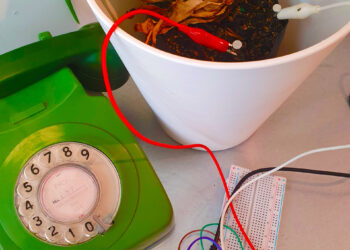
Kim Newall has been experimenting with soil moisture sensors which measure the water content in the soil, which is crucial for understanding plant hydration and irrigation needs. Also, light sensors that monitor light intensity and duration(essential for optimizing photosynthesis and assessing plant growth conditions). He is also tracking temperature and humidity, which can aid in identifying temperature stress and optimizing growth environments (see image left).
In addition, scientists (in controlled conditions) can detect volatile organic compounds (VOCs) emitted by plants, providing insights into their health status and responses to biotic and abiotic stressors. Some specialised sensors, such as sap flow sensors, measure the rate of sap movement within plants, offering valuable information on water uptake and transpiration rates.
These sensors and advancements in wireless communication and data analytics enable precise and real-time monitoring of plant health and environmental conditions, facilitating informed agricultural, ecology, and research decision-making.
ElectroPhysiological Signal Monitoring
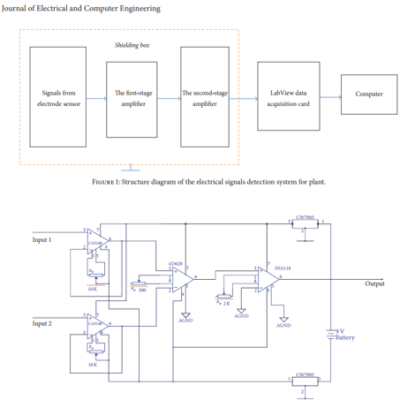
An article by Weiming Cai and Qingke Qi (2017) forms the basis for Frederico’s own plant sensor research: Study on Electrophysiological Signal Monitoring of Plant under Stress Based on Integrated Op-Amps and Patch Electrode
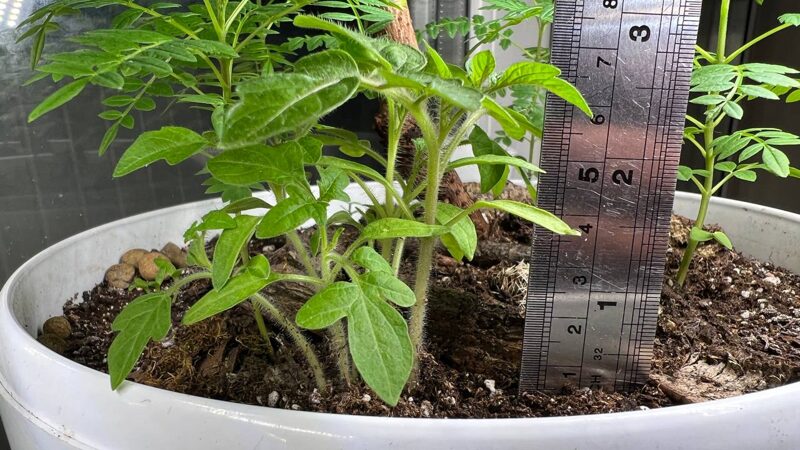
He is interested in capturing the electrical signal emanating from plants, amplifying it and sending it via our BioSignals protocols. He has used Cai and Qi’s (2017) article as the basis to design, print and test hardware to gather and amplify signals directly from plants – in his case Tomato Plants (pictured above).
Hardware Prototyping
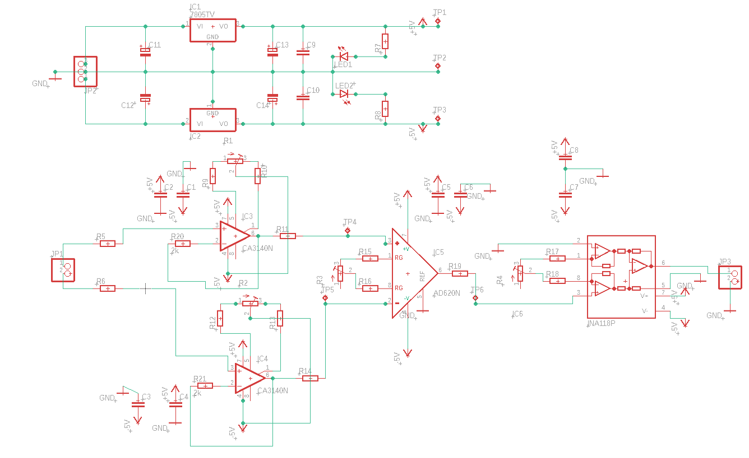
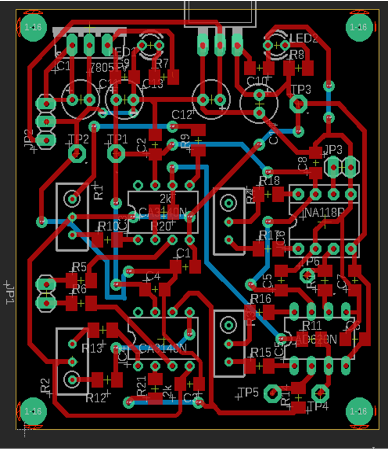
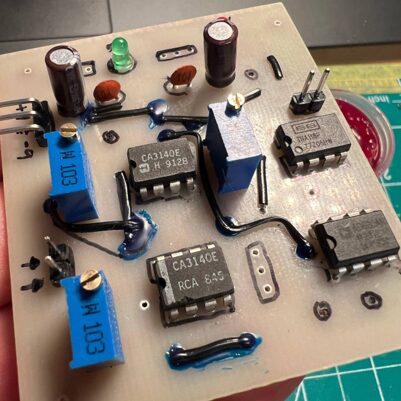
Frederico has been designing an amplifying circuit board based on Cai and Qi’s (2017) schematic.
Frederico’s adapted version of the schematic and beautifully home-printed and assembled circuit board is presented in the images at the right of the screen. (Images Frederico’s own).
More details to come as the experiments evolve. If you wish to learn more about Frederico check out his Instagram page @fxpear and here is more about SEADS

More BioSignals

Strange Intelligences Lab Open Studio and BioSignals
As part of the Whangarei Fringe Festival, we opened our studio to conduct community-based research for the culmination of the BioSignals Project and as a way to feed our Strange Intelligences Lab…

BioSignals: Signals into Space!
We have sent test data into space! This exciting development results from research into grass-roots options for connecting to space from rural communities - part of our focus on building resilience. Using…

BioSignals: Printing Mugwort
The UK bioSignals team is creating banners made from elements produced by our international teams. We decided to print and send our favourite plant, Mugwort. Our Mugwort has been growing voraciously in…

Interview with Kieran Monaghan
Kieran Monaghan - is predominantly, and persistently, a drummer and percussionist of found sounds. He calls Te Whanganui-a-Tara/Wellington home. His first crude musical steps were in the late 80’s, playing drums in…

BioSignals: Plant Ethics and Msc Presentations
in July/August the New Zealand bioSignals research team has been sharing research and perspectives in short presentations to stimulate thinking and enrich cross-cultural exchange. Presentations in PDF and Video below. {{ vc_btn:…

BioSignals First NZ Milestone Achieved
With the launch of the Alternative Reality Gardening Lab our bioSignals research could be tested with the public. Our Central Garden Lab—the project's hub—had several projects in some form of display so…

Ecosystem Signals Crossing the World
Everywhere you go, always take the weather with you - Crowded House So we are sending our mad Northland weather globally in our bioSignals project via our weather station, which has been…

BioSignals: Interview with Kelly Kahukiwa
Kelly Kahukiwa (Ngāti IO, Ngāti Whakaue, Ngai Tūhoe and Te Aitanga -ā Māhaki) is an artist, musician, intercultural leader and indigenous researcher. Kelly’s artistic practice spans many contemporary and traditional forms, including…

Resilience Garden Update: Image Gallery
A BioSignals documentation post is showing the latest growth in our resilience garden. We have beautiful flowers in our resilience garden and massive autumnal growth. The mugwort seedlings are thriving, and abundance…
Installation Prototyping
Plants are sending signals within a suburban mall thanks to Kim's hard work today on our bioSignals project. Our shop in The Strand Arcade now has the bones of an installation in…

Foraging and Propagating Wormwood
It shows you the folly of resentment, judgement and rage. Gregg (2014) Artemisia Absyinthium, is a repellent herb that hatefully banishes other plants or animals that come too close. Cunningham (1998)…

The Magic of Mugwort
Mugwort - a powerful medicinal plant is now in our garden! Mugwort, scientifically known as Artemisia vulgaris, is a versatile and aromatic herb cherished for centuries for its medicinal, magical and culinary…
Capturing Hitchhikers: Image Gallery
A BioSignals documentation post for an expedition to AH Reed Public Park 24 Feb 24 Yesterday, we visited AH Reed Park as an expedition a new AwhiWorld project and to support…

Sansar VR Experiments 2
BioSignals research has led to live visualisation of data in VR. Daniël Vandersmissen, our colleague in Belgium, has been working with Sansar. As a result of his latest experiment, Kim's live…

Hardware Experiments – Outside Sensors
A second prototype IoT system is now set-up outside in our resilience garden. Kim set this system up for our BioSignals project using the same hardware and sensor configuration as our…

Sansar VR Experiments
BioSignals research includes signal transfer in and out of virtual worlds. Daniël Vandersmissen, our colleague in Belgium, is experimenting with the Sansar Virtual World. Sansar is a virtual reality platform that…

Capturing Weeds: Image Gallery
Documentation post for weeds collected around our property for the BioSignals project. {{ vc_btn: title=Learn+More+About+BioSignals&shape=square&color=success&size=lg&align=center&link=url%3Ahttps%253A%252F%252Fawhiworld.com%252Fportfolio%252Fbiosignals%252F%7Ctarget%3A_blank }} More BioSignals The British Council funds BioSignals via the #ConnectionsThroughCulture programme.

Pathways to Resilience
BioSignals continues ... our resilience garden is coming along nicely. We've been out in the garden, preparing pathways, mulching and planting in and around our Resilience Garden (formerly The Chicken Garden). …

BioSignals: Interview with Cr Jack Craw
Cr Jack Craw is a seasoned biosecurity and biodiversity management expert with a career spanning over forty years. Currently serving as a Regional Councillor for the Northland Regional Council, Jack brings extensive…

BioPlastic Experiments
BioSignals and bioplastics - experiments with resilient and highly noxious weeds. Stopping the Moth Plant (Araujia hortorum) in its tracks is many a conservationist's dream. In NZ, the plant is disturbingly known…

Binding the Binders
Strangling, smothering and suffocating - disturbing traits that make certain plants extremely resilient. But how do we capture this resilience artistically and magically? In this post, Maggie shares her experiments for BioSignals…
Weeding for BioSignals
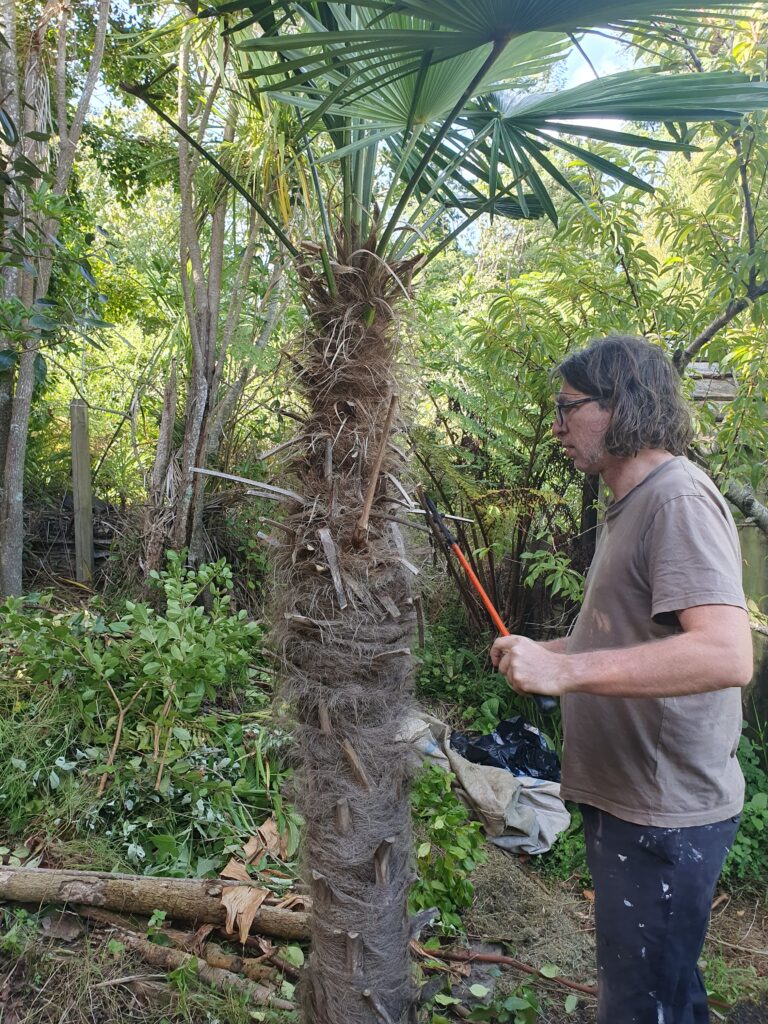
We are getting into the weeds for our research for BioSignals. Taking advantage of the long weekend for Waitangi Day, Kim and I have been working hard on our garden, plant…

Climate Change, Biodiversity and IoT
BioSignals explores climate change and biodiversity using IoT systems to generate and send signals from plants. Climate change is causing extreme weather events to increase, altering rainfall patterns, raising temperatures, and warming…

Proof of Concept – BioSignals
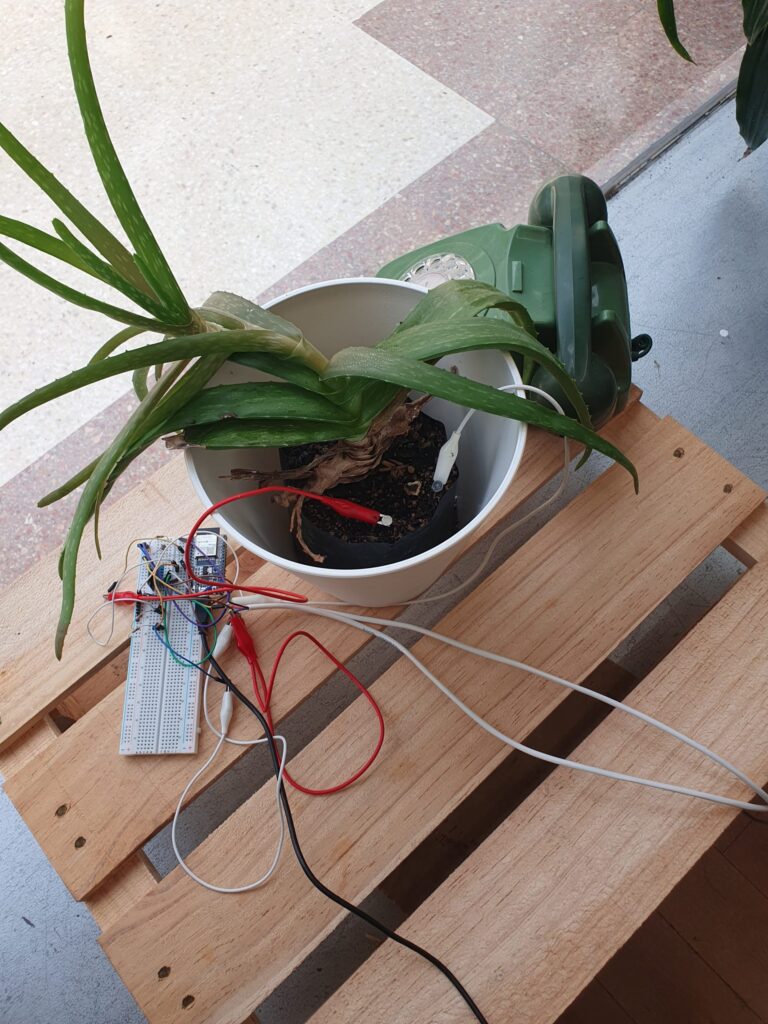
BioSignals has begun! Kim has set up a prototype IoT-based biosignal system using the Aloe Vera plant in our studio space. The system configuration is: ESP32 microcontroller Sensors: DHT11 (temperature and humidity), Light-dependent…

Invoking Resilience and Protection
Plants are essential for human existence, giving us air, food and shelter. For many cultures, they are also at the core of cultural and spiritual practice. Providing protection, supporting resilience and expanding…

Peering at Plants
Microscopy is a core part of AwhiWorld's practice whether it be a live performance or teaching people about the unseen world of plants in our innovation labs. A core part of Maggie's…

The British Council funds BioSignals via the #ConnectionsThroughCulture programme.